The Complete UK Small Business Trust & Growth Guide
How Sole Traders and SMEs Can Build Trust, Get More Customers, Collect Reviews, Handle Complaints, and Grow Their Business Online
A Practical Guide for UK Tradespeople, Freelancers, Consultants and Small Businesses
Table of Contents
- Why Trust Matters More Than Marketing
- How Customers Choose Businesses Today
- How to Promote Your Business Online for Free
- How to Build Customer Trust
- The Power of Customer Reviews
- Why Trust Seals Increase Enquiries
- Alternatives to Traditional Review Platforms
- How to Handle Customer Complaints Professionally
- Why Accountability Is the New Competitive Advantage
- Building a Complete Trust Framework for Your Business
- How BBBB Helps UK Small Businesses Build Trust
- Frequently Asked Questions
Why Trust Matters More Than Marketing
Many small business owners spend a lot of time thinking about marketing.
They ask questions like:
- How can I get more customers?
- How can I rank higher on Google?
- How can I promote my business online?
- Which social media platform should I use?
These are all important questions.
However, there is one factor that often has a greater impact than marketing itself:
Trust.
You can drive hundreds of visitors to your business profile, social media page, or website.
But if those visitors do not trust your business, they will not become customers.
Trust influences:
- Enquiries
- Phone calls
- Quote requests
- Bookings
- Referrals
- Repeat business
For sole traders and SMEs, trust is often the difference between success and failure.
How Customers Choose Businesses Today
Twenty years ago, many customers relied on recommendations from friends and family.
Today, most customers start online.
Before making contact, they often search for:
- Reviews
- Testimonials
- Business profiles
- Social media pages
- Photos
- Credentials
- Trust signals
They want reassurance.
They want evidence.
They want confidence that they are making a good decision.
This is particularly true when hiring:
- Builders
- Electricians
- Plumbers
- Accountants
- Consultants
- Freelancers
- Tradespeople
Customers want to know they can trust the person they are hiring.
How to Promote Your Business Online for Free
One of the biggest myths in business is that you need an expensive website or advertising campaign to get customers.
The reality is very different.
There are several highly effective free ways to increase visibility online.
Google Business Profile
Google Business Profile remains one of the most powerful free marketing tools available.
A complete profile helps your business appear in:
- Google Search
- Google Maps
- Local searches
If you have not already done so, creating and optimising a Google Business Profile should be a priority.
Social Media
Social media platforms provide free opportunities to:
- Showcase your work
- Share reviews
- Demonstrate expertise
- Build relationships
Different platforms suit different businesses.
For example:
- Facebook works well for local businesses
- Instagram works well for visual trades
- LinkedIn works well for consultants and professionals
The key is consistency rather than perfection.
Business Directories
Business directories remain an important source of visibility.
They help:
- Customers discover your business
- Search engines verify your existence
- Build credibility through consistent information
A professional business profile can often provide visibility even without a website.
Related Reading
How to Promote Your Business Online for Free in the UK (Without a Website)
This article explains step-by-step methods to increase visibility using free tools and business profiles.
How to Promote Your Business Online for Free in the UK (Even Without a Website)
How to Build Customer Trust
Visibility gets attention.
Trust wins customers.
There are several practical ways to increase trust.
Collect Reviews
Reviews are one of the strongest trust signals available.
Customers often compare businesses based on:
- Number of reviews
- Quality of reviews
- Consistency of feedback
A business with ten genuine reviews often appears more trustworthy than a business with none.
Display Credentials
Qualifications and certifications help reassure customers.
Examples include:
- Trade memberships
- Professional qualifications
- Insurance details
- Industry certifications
These help reduce uncertainty.
Use Professional Photos
Customers trust what they can see.
Photos help demonstrate:
- Quality of work
- Professionalism
- Experience
Good photographs can significantly increase confidence.
Related Reading
How UK Sole Traders Can Build Customer Trust and Win More Business
This guide explores practical trust-building strategies specifically for sole traders and small businesses.
How UK Sole Traders and small business Can Build Customer Trust and Win More Business
The Power of Customer Reviews
Reviews provide something advertising cannot:
Independent social proof.
Customers trust other customers.
That is why reviews have become one of the most influential factors in purchasing decisions.
Research consistently shows that businesses with positive reviews are more likely to receive enquiries.
When Should You Ask for Reviews?
The best time is usually:
- Immediately after successful completion
- When the customer is happy
- Before too much time passes
How Should You Ask?
Keep it simple.
For example:
“Thank you for choosing us. If you were happy with the work, we would really appreciate a quick review.”
Short and genuine requests often work best.
SMS and WhatsApp Review Requests
Many tradespeople achieve excellent results using:
- SMS
The easier you make it for customers, the more reviews you will receive.
Related Reading
How Tradespeople Can Ask for, Collect, and Display Customer Reviews
This article explains practical review collection strategies that work.
How Tradespeople Can Ask for, Collect, and Display Customer Reviews
Why Trust Seals Increase Enquiries
A Trust Seal acts as a visual reassurance signal.
Customers see:
- Reviews
- Profiles
- Trust badges
and instantly feel more confident.
Trust Seals reduce uncertainty.
That confidence often increases:
- Click-through rates
- Enquiries
- Conversion rates
Businesses that display strong trust signals frequently outperform competitors who do not.
Where Should Trust Seals Be Displayed?
Online:
- Business profiles
- Websites
- Social media pages
- Email signatures
Offline:
- Business cards
- Flyers
- Vehicle graphics
- Quotations
The more visible your trust signals, the stronger their impact.
Related Reading
What Is a Trust Seal and Why Does Your Business Need One?
Learn how trust badges influence customer behaviour and purchasing decisions.
Alternatives to Traditional Review Platforms
As customer reviews have become more important, many businesses have naturally looked towards major review platforms.
While these platforms can be useful, many sole traders and SMEs find that they are not always designed around the needs of smaller businesses.
Common concerns include:
- Cost
- Complexity
- Limited control
- Focus on reviews rather than trust
For many sole traders, the goal is actually much simpler:
- Create a professional profile
- Collect reviews
- Build trust
- Demonstrate accountability
without paying hundreds of pounds per year.
What Should SMEs Look For?
When evaluating review and trust platforms, small businesses should consider:
Affordability
Can the platform deliver value without requiring a large monthly commitment?
Simplicity
Can you get started quickly?
Trust Signals
Does the platform help customers feel confident?
Visibility
Can potential customers find your business?
Accountability
Can customers see how concerns and complaints are handled?
Increasingly, customers want more than star ratings.
They want reassurance.
Related Reading
Trustpilot Alternatives for UK Small Businesses: Better Options for Sole Traders and SMEs
This article compares review platforms and explores why many SMEs are looking for alternatives that are more aligned with their needs.
Trustpilot Alternatives for UK Small Businesses: Are There Better Options for Sole Traders and SMEs?
How to Handle Customer Complaints Professionally
One of the biggest trust-building opportunities available to any business is how it handles complaints.
Most businesses view complaints as a threat.
However, customers often see complaints differently.
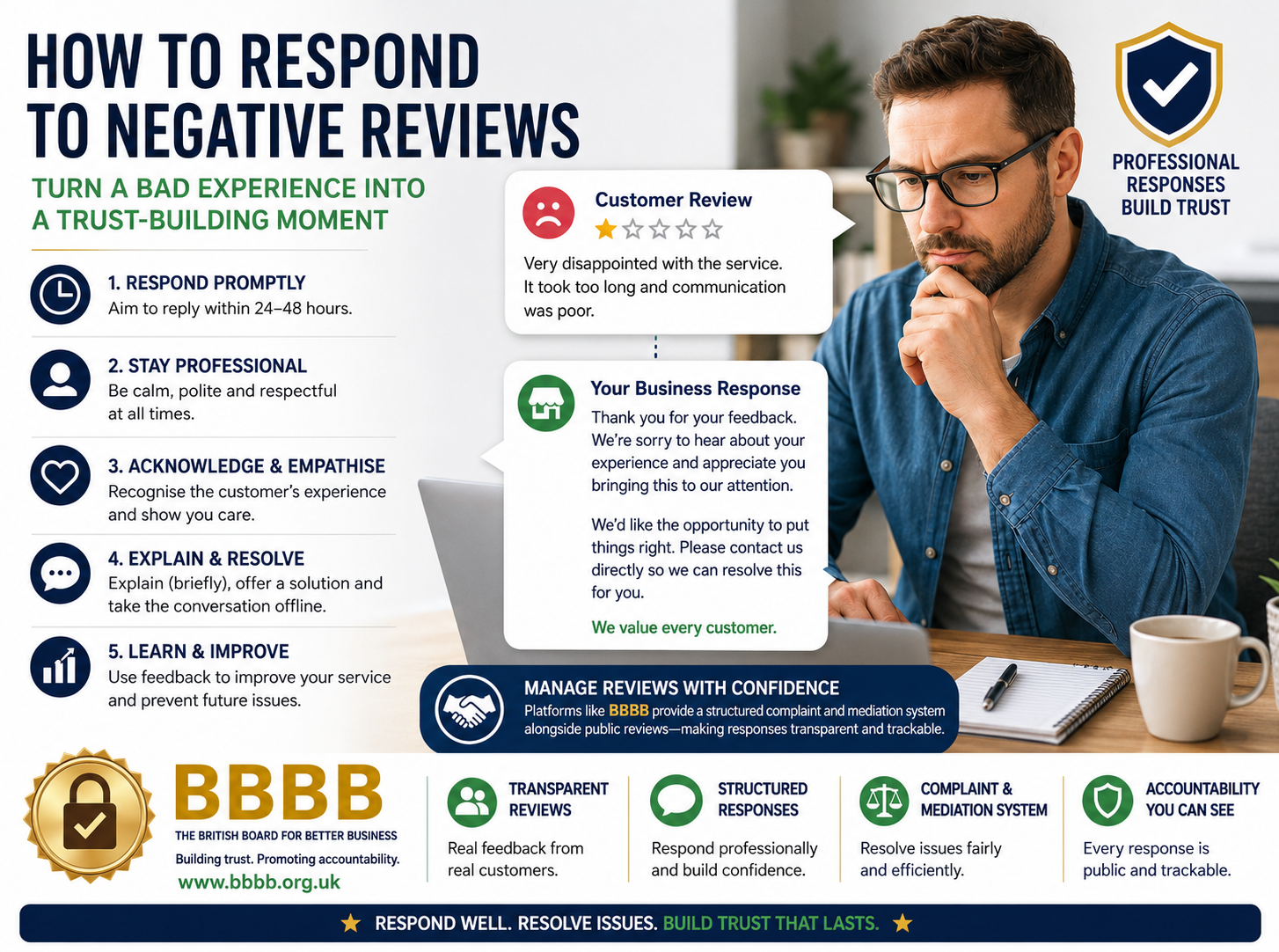
Customers understand:
- Mistakes happen
- Delays occur
- Misunderstandings arise
What matters most is how a business responds.
A Professional Complaint Process
A simple process looks like this:
Step 1
Acknowledge the complaint quickly.
Step 2
Listen carefully.
Step 3
Gather facts and documentation.
Step 4
Communicate professionally.
Step 5
Focus on solutions.
Step 6
Confirm the outcome.
Step 7
Learn from the experience.
This approach not only helps resolve issues but also demonstrates professionalism.
Why Transparency Matters
Future customers often judge businesses based on:
- How they respond
- How quickly they respond
- Whether they take responsibility
A professional response can actually increase trust.
In some cases, customers trust businesses that handle complaints well more than businesses that appear to have no complaints at all.
Related Reading
How UK Small Businesses Can Handle Customer Complaints Professionally
A complete step-by-step guide to protecting your reputation while resolving customer concerns.
How UK Sole Traders and Small Businesses Can Handle Customer Complaints Professionally
Accountability Is Becoming a Competitive Advantage
For many years, businesses focused on marketing.
Today, customers increasingly focus on accountability.
They want to know:
- Will this business respond?
- Will this business stand behind its work?
- What happens if something goes wrong?
This shift creates an opportunity for good businesses.
Businesses that demonstrate transparency often outperform businesses that simply advertise more.
What Accountability Looks Like
Accountability can be demonstrated through:
- Reviews
- Public responses
- Complaint handling
- Transparent communication
- Professional profiles
Customers appreciate businesses that are willing to engage openly.
Building a Complete Trust Framework
Trust is rarely built through one thing alone.
Instead, trust comes from a combination of factors.
Think of it as a framework.
Visibility
Can customers find you?
Examples:
- Google Business Profile
- Social media
- Business directories
Credibility
Can customers verify you?
Examples:
- Reviews
- Qualifications
- Professional memberships
Trust Signals
Can customers quickly assess you?
Examples:
- Trust Seals
- Testimonials
- Verified profiles
Accountability
Can customers see how you handle issues?
Examples:
- Complaint responses
- Transparent communication
- Resolution processes
The businesses that combine all four tend to perform best.
How BBBB Helps UK Small Businesses Build Trust
BBBB was created because many sole traders and SMEs need a practical and affordable way to demonstrate trust online.
Rather than focusing solely on reviews, BBBB combines multiple trust-building tools in one place.
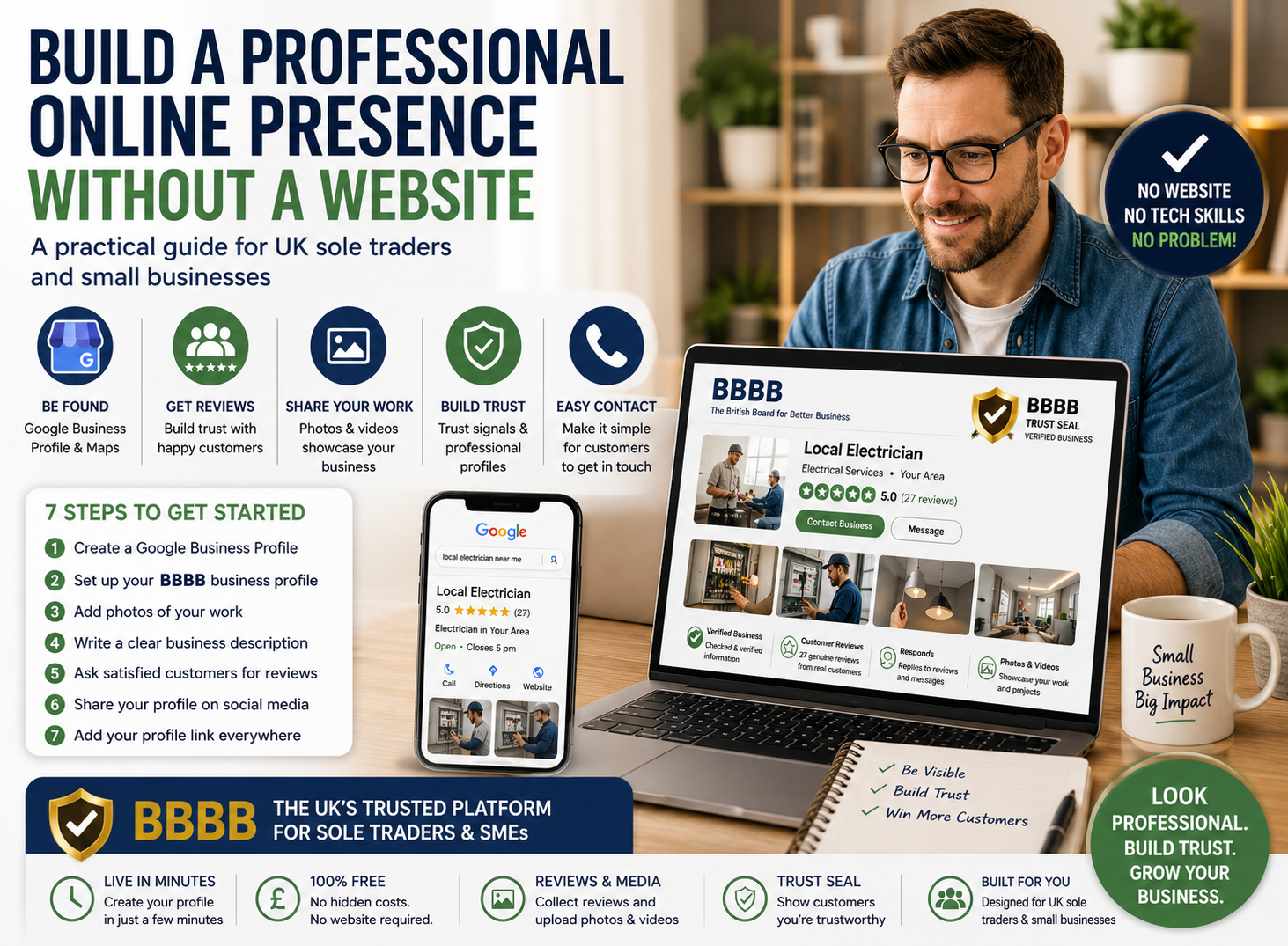
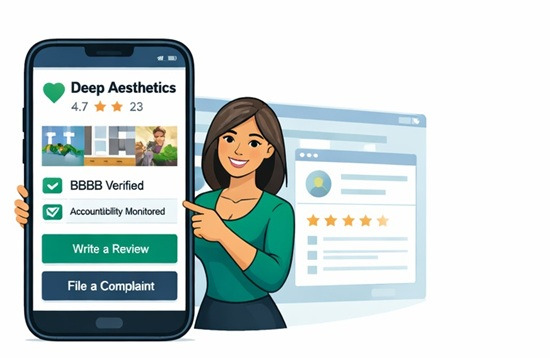
A BBBB Profile Includes
- Business information
- Customer reviews
- Photos and videos
- Customer communication tools
- Social sharing features
- A BBBB Trust Seal
No Website Required
Many small businesses do not have websites.
That should not prevent them from building trust online.
A BBBB profile can be created in under two minutes and provides a professional online presence without the cost of building and maintaining a website.
Accountability Built In
One of the most distinctive features of BBBB is its focus on accountability.
Customers can:
- Leave reviews
- Raise concerns
- Receive responses
Businesses can:
- Respond professionally
- Demonstrate transparency
- Show accountability
This helps future customers make informed decisions.
Why This Matters
The future of online trust is unlikely to be based solely on ratings.
Customers increasingly want to understand:
“How does this business behave when things go wrong?”
Businesses that can answer that question professionally have a significant advantage.
Your Practical Action Plan
If you’re a sole trader or small business owner, here is a simple trust-building roadmap.
Week 1
Create:
- Google Business Profile
- Social media presence
- BBBB profile
Week 2
Add:
- Photos
- Service descriptions
- Contact details
Week 3
Request reviews from:
- Existing customers
- Recent customers
Week 4
Display trust signals:
- Reviews
- BBBB Trust Seal
- Qualifications
Ongoing
- Respond to feedback
- Update profiles
- Maintain visibility
- Demonstrate accountability
Final Thoughts
The businesses that thrive online are not always the biggest.
They are often the businesses that customers trust most.
Trust is built through:
- Visibility
- Reviews
- Professionalism
- Transparency
- Accountability
The good news is that none of these require a huge budget.
By using the strategies outlined in this guide, sole traders and SMEs can build a powerful online presence, strengthen customer confidence, and create sustainable business growth.
Ready to Build Trust?
Whether you’re just starting out or looking to strengthen your reputation, BBBB provides a simple and affordable way to build trust online.
Create your free BBBB profile today
Get your BBBB Trust Seal
Learn how BBBB helps businesses demonstrate accountability
Frequently Asked Questions
Do I need a website to build trust online?
No. Many businesses successfully use Google Business Profile, social media, business directories, and BBBB profiles without owning a website.
What is the fastest way to build trust?
Collect reviews, display trust signals, use professional photos, and maintain a complete business profile.
How important are customer reviews?
Reviews are one of the strongest trust signals available and can significantly influence customer decisions.
Why do trust badges work?
Trust badges help customers feel confident that a business is professional, accountable, and credible.
How does BBBB help sole traders?
BBBB provides a free business profile, customer reviews, Trust Seal, communication tools, and a transparent accountability framework designed specifically for UK sole traders and SMEs.
Where can I create a free BBBB profile?
Visit:
and get started in under two minutes.