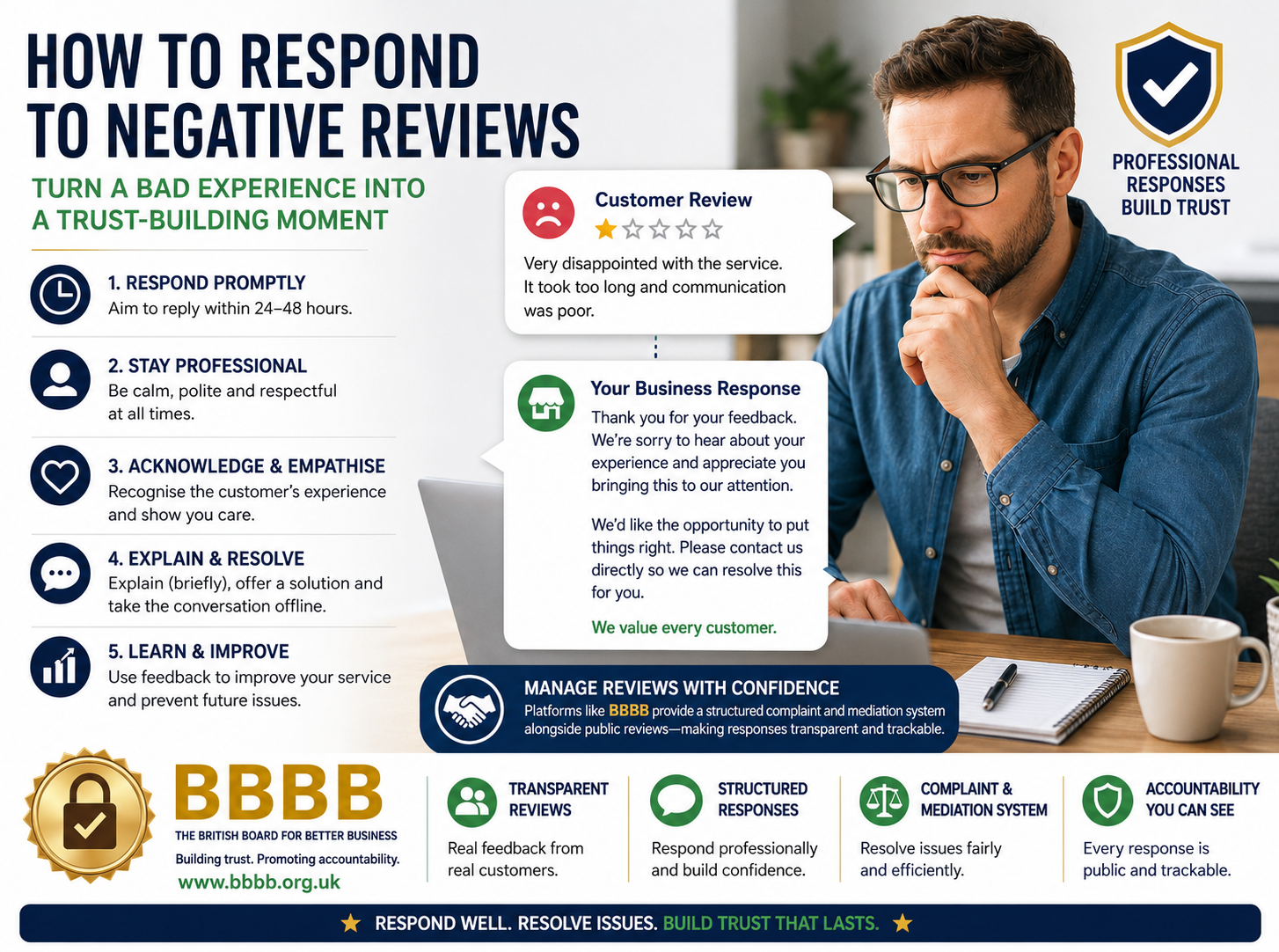
How UK Sole Traders and Small Businesses Can Handle Customer Complaints Professionally
A Practical Guide to Resolving Problems, Protecting Your Reputation, and Building Customer Trust
No matter how good your business is, customer complaints are inevitable.
Even the most professional sole traders and small businesses occasionally encounter misunderstandings, delays, miscommunication, or customers who simply feel dissatisfied.
The difference between a successful business and a struggling one is often not whether complaints occur, but how they are handled.
When managed professionally, a complaint can actually strengthen customer trust and improve your reputation.
In this guide, we’ll look at practical steps UK sole traders and SMEs can take to handle customer complaints effectively and professionally.
Why Customer Complaints Matter
Many business owners see complaints as a problem.
In reality, complaints can be valuable feedback.
They can help you:
- Identify weaknesses
- Improve customer service
- Resolve misunderstandings
- Demonstrate professionalism
- Build trust with future customers
Customers understand that mistakes happen.
What they want to see is how a business responds when something goes wrong.
1. Respond Quickly
One of the most common causes of escalation is delay.
When a customer feels ignored, frustration often increases.
As a general rule:
Acknowledge complaints within:
- 24 hours where possible
- 48 hours at the latest
Even if you cannot immediately solve the problem, acknowledging it demonstrates professionalism.
A simple response can be enough:
“Thank you for bringing this to our attention. We are reviewing the matter and will get back to you shortly.”
This reassures the customer that their concern is being taken seriously.
2. Stay Calm and Professional
Complaints can sometimes feel personal.
However, it is important not to respond emotionally.
Avoid:
- Arguments
- Blame
- Defensive language
- Emotional reactions
Instead:
- Stay polite
- Remain professional
- Focus on the facts
- Look for solutions
Remember that future customers may also see your responses.
Professional communication can significantly improve trust.
3. Listen Before Responding
Many complaints escalate because customers feel they are not being heard.
Before replying:
- Read the complaint carefully
- Understand the issue fully
- Clarify any missing information
Sometimes customers simply want acknowledgment and understanding.
Listening properly often reduces tension immediately.
4. Keep Written Records
Good documentation protects both you and your customer.
Keep records of:
- Emails
- Messages
- Quotes
- Invoices
- Photographs
- Notes from conversations
This information can help clarify misunderstandings and support fair outcomes.
For sole traders especially, organised records can prevent disputes becoming larger problems.
5. Focus on Solutions
The goal is not to win an argument.
The goal is to resolve the issue.
Ask yourself:
- What outcome is the customer seeking?
- Is there a reasonable compromise?
- Can the issue be corrected?
Customers often appreciate businesses that genuinely try to help.
Even when a perfect solution isn’t possible, effort and communication can make a significant difference.
6. Be Honest and Transparent
If a mistake has been made:
Admit it.
Most customers appreciate honesty.
Attempting to hide mistakes often causes more damage than the original issue.
Transparency helps build long-term trust.
7. Set Clear Response Times
Customers appreciate knowing what to expect.
Provide realistic timelines.
For example:
- “We’ll investigate and respond within 3 working days.”
- “We’ll review the information and update you by Friday.”
Clear expectations reduce uncertainty and frustration.
8. Learn from Every Complaint
Every complaint provides an opportunity to improve.
After resolving an issue, ask:
- What caused this?
- Could it be prevented in future?
- Do we need to improve communication?
- Are our processes clear enough?
Businesses that learn from complaints often improve faster than those that ignore them.
9. Public Responses Matter
Increasingly, customer feedback is visible online.
When responding publicly:
- Remain polite
- Avoid personal attacks
- Address the issue professionally
- Show willingness to help
Potential customers often judge a business based on its responses rather than the complaint itself.
A professional response can actually increase trust.
10. Use Structured Complaint Processes
Many sole traders handle complaints informally.
As a business grows, this can become difficult to manage.
Having a structured process helps ensure:
- Consistency
- Fairness
- Professional communication
- Better record keeping
Even a simple system can make complaint handling much easier.
How BBBB Can Help Sole Traders and SMEs
Many sole traders do not have formal customer service departments or complaint management systems.
Platforms such as BBBB help provide a simple framework for handling customer concerns professionally.
BBBB allows businesses to:
- Maintain a public business profile
- Collect customer reviews
- Respond to customer concerns
- Demonstrate accountability
- Build customer trust
For businesses that want a more structured approach without investing in expensive systems, BBBB provides a practical solution.
The platform also supports transparent communication and helps customers see how businesses engage with feedback and complaints.
Common Complaint Handling Mistakes
Avoid these common errors:
- Ignoring complaints
- Responding emotionally
- Delaying communication
- Failing to keep records
- Arguing publicly
- Refusing to acknowledge concerns
These mistakes often create larger problems than the original complaint.
A Simple Complaint Handling Process
A practical process might look like this:
Step 1
Receive the complaint
Step 2
Acknowledge within 24–48 hours
Step 3
Gather facts and documentation
Step 4
Communicate clearly and professionally
Step 5
Propose a solution
Step 6
Record the outcome
This simple framework can help resolve many issues before they escalate.
Final Thoughts
Customer complaints are a normal part of running any business.
Handled correctly, they can become opportunities to demonstrate professionalism, improve customer relationships, and strengthen your reputation.
Customers do not expect perfection.
They expect fairness, communication, and accountability.
Businesses that respond professionally to complaints often build stronger trust than businesses that never receive complaints at all.
About BBBB
BBBB helps UK sole traders and small businesses build trust online through professional business profiles, customer reviews, Trust Seals, and transparent accountability.
Businesses can create a free profile in under two minutes and use BBBB’s complaint handling framework to demonstrate professionalism and customer commitment.
Learn more at:
Frequently Asked Questions
How quickly should I respond to a customer complaint?
Ideally within 24 hours and no later than 48 hours.
Should I respond publicly to complaints?
Yes, where appropriate. Professional public responses can increase trust and demonstrate accountability.
Why is documentation important?
Documentation helps clarify facts, protect both parties, and support fair resolutions.
Can customer complaints actually help my business?
Yes. Complaints often identify opportunities to improve service and strengthen customer trust.
How can BBBB help with complaint handling?
BBBB provides a structured framework for collecting feedback, responding to concerns, demonstrating accountability, and building trust with customers.