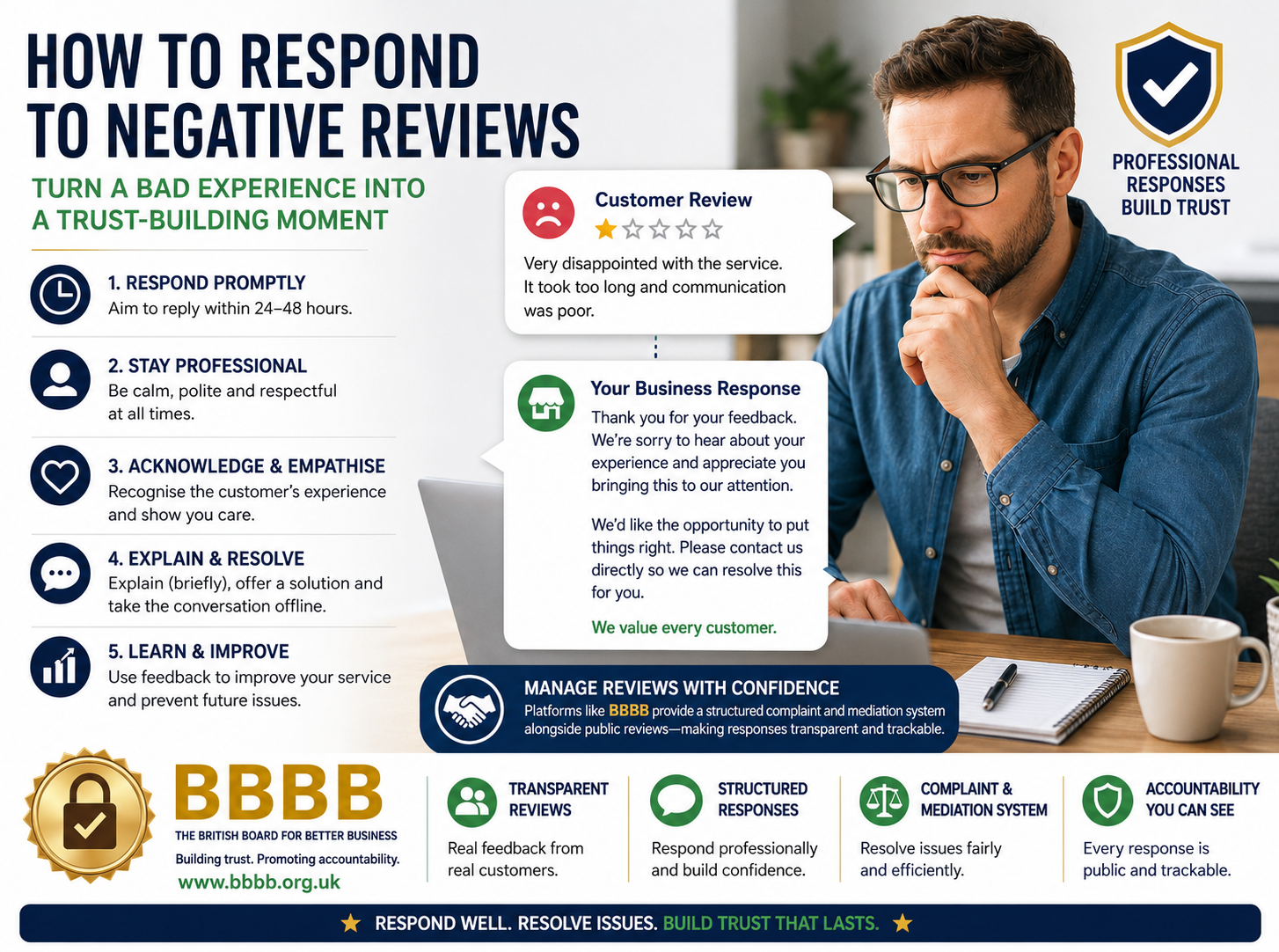
How to Handle Customer Complaints Professionally: A Step-by-Step Guide for UK Small Businesses
Turn Customer Complaints Into Opportunities to Build Trust and Strengthen Your Reputation
Most small business owners dread receiving a complaint.
Whether you’re a sole trader, tradesperson, freelancer, consultant, retailer, or local service provider, customer complaints can feel stressful and personal.
However, successful businesses understand something important:
Complaints are not the problem. Poor complaint handling is.
In fact, a professionally handled complaint can often increase customer trust, improve your reputation, and even generate future business.
This guide provides a practical step-by-step complaint handling process that UK sole traders and small businesses can implement immediately.
Why Complaint Handling Matters
No business is perfect.
Customers understand that:
- Mistakes happen
- Deliveries can be delayed
- Misunderstandings occur
- Expectations sometimes differ
What customers really care about is:
- How quickly you respond
- How professionally you communicate
- Whether you take responsibility
- Whether you try to resolve the issue fairly
In many cases, customers judge businesses more by their response than by the original complaint.
Step 1: Acknowledge the Complaint Promptly
The worst thing you can do is ignore a complaint.
When customers feel ignored, frustration often increases.
As a general rule:
Respond within:
- 24 hours where possible
- 48 hours at the latest
Even if you don’t have a solution yet, acknowledge the issue.
Example:
“Thank you for bringing this to our attention. We’re reviewing the matter and will get back to you shortly.”
This simple message demonstrates professionalism and reassurance.
Step 2: Listen Before You Respond
One of the biggest mistakes businesses make is responding before fully understanding the issue.
Before replying:
- Read the complaint carefully
- Gather all relevant information
- Review previous communications
- Check invoices, quotes, and records
Ask yourself:
- What exactly happened?
- Why is the customer unhappy?
- What outcome are they seeking?
Understanding the problem fully often prevents escalation.
Step 3: Stay Professional and Avoid Emotion
Complaints can sometimes feel unfair.
However, emotional responses rarely improve situations.
Avoid:
- Arguments
- Defensive language
- Personal comments
- Public disputes
Instead:
- Remain calm
- Focus on facts
- Show empathy
- Look for solutions
Remember:
Future customers may eventually see how you handled the situation.
Step 4: Keep Good Documentation
Documentation is one of the most effective ways to protect both your business and your customers.
Keep records of:
- Emails
- Text messages
- WhatsApp conversations
- Quotes
- Invoices
- Photos
- Job notes
Good documentation helps:
- Clarify misunderstandings
- Support fair decisions
- Reduce future disputes
For sole traders, organised records can save significant time and stress.
Step 5: Investigate Fairly
Before proposing a solution:
- Gather all facts
- Review evidence
- Speak to relevant parties if necessary
Avoid making assumptions.
A fair investigation helps ensure the outcome is reasonable for everyone involved.
Step 6: Communicate Clearly
Customers appreciate transparency.
Tell them:
- What you’re doing
- When they can expect updates
- What happens next
For example:
“We’re currently reviewing the information provided and expect to update you within three working days.”
Clear communication helps reduce frustration and uncertainty.
Step 7: Focus on Resolution, Not Blame
Your goal is not to win an argument.
Your goal is to resolve the issue.
Potential solutions may include:
- Corrective work
- Replacement products
- Partial refunds
- Clarification
- Apologies where appropriate
Customers often appreciate genuine effort even when a perfect solution isn’t possible.
Step 8: Confirm the Outcome in Writing
Once a resolution is agreed:
Document it.
Include:
- What has been agreed
- Any actions required
- Timescales
- Next steps
Written confirmation creates clarity and helps avoid future misunderstandings.
Step 9: Learn from Every Complaint
Every complaint contains valuable information.
Ask yourself:
- What caused the issue?
- Could it have been prevented?
- Do we need to improve communication?
- Are our systems clear enough?
Businesses that learn from complaints often improve faster than those that ignore them.
Step 10: Protect Your Reputation Through Transparency
Today, customers often research businesses before making contact.
They look for:
- Reviews
- Testimonials
- Complaints
- Business responses
Many customers understand that complaints happen.
What they want to see is:
How does this business respond when things go wrong?
Professional responses can actually increase customer confidence.
Turning Complaints Into Trust-Building Opportunities
Most businesses view complaints as damage control.
The best businesses view complaints as trust-building opportunities.
A business that:
- Responds quickly
- Communicates professionally
- Documents carefully
- Resolves fairly
often appears more trustworthy than a business with no visible feedback at all.
This is because transparency demonstrates accountability.
Why Accountability Is Becoming More Important
Customer expectations are changing.
People increasingly want to know:
- Is this business responsive?
- Do they take responsibility?
- How do they handle problems?
Businesses that can demonstrate accountability have a significant competitive advantage.
How BBBB Helps Small Businesses Handle Complaints Professionally
Many sole traders and small businesses do not have formal complaint handling systems.
Platforms such as BBBB provide a simple framework that helps businesses manage customer concerns professionally.
BBBB allows businesses to:
- Receive customer feedback
- Respond to concerns
- Demonstrate accountability
- Show resolutions
- Build customer trust
Importantly, BBBB helps make accountability visible.
Future customers can see that a business is willing to engage professionally and resolve issues fairly.
Rather than hiding complaints, BBBB helps businesses demonstrate how they handle them.
For many customers, this can be a powerful trust signal.
Common Complaint Handling Mistakes
Avoid:
❌ Ignoring complaints
❌ Delaying responses
❌ Responding emotionally
❌ Failing to document conversations
❌ Arguing publicly
❌ Making promises you cannot keep
Professionalism and consistency almost always produce better outcomes.
A Simple Complaint Handling Workflow
Receive Complaint
↓
Acknowledge Quickly
↓
Gather Information
↓
Investigate Fairly
↓
Communicate Clearly
↓
Agree Resolution
↓
Confirm Outcome
↓
Learn and Improve
This simple framework works for most small businesses.
Final Thoughts
Customer complaints are an unavoidable part of running a business.
Handled badly, they can damage trust.
Handled professionally, they can strengthen it.
By responding promptly, communicating clearly, documenting carefully, and focusing on solutions, UK sole traders and SMEs can turn complaints into opportunities to demonstrate professionalism and accountability.
Customers may forget the original problem.
But they rarely forget how they were treated.
About BBBB
BBBB helps UK sole traders and small businesses build trust online through business profiles, customer reviews, Trust Seals, and transparent accountability.
Businesses can create a free profile in under two minutes and use BBBB’s complaint handling and mediation framework to demonstrate professionalism and customer commitment.
Learn more at:
Frequently Asked Questions
How quickly should I respond to a customer complaint?
Ideally within 24 hours and no later than 48 hours.
Should complaints always be documented?
Yes. Written records help protect both the business and the customer.
Can complaints actually improve customer trust?
Yes. Customers often judge businesses by how they handle problems rather than whether problems occur.
Why is accountability important?
Accountability demonstrates professionalism and reassures future customers that concerns will be handled fairly.
How does BBBB help businesses manage complaints?
BBBB provides a structured complaint resolution and mediation framework that allows businesses to respond professionally, demonstrate accountability, and build trust with future customers.