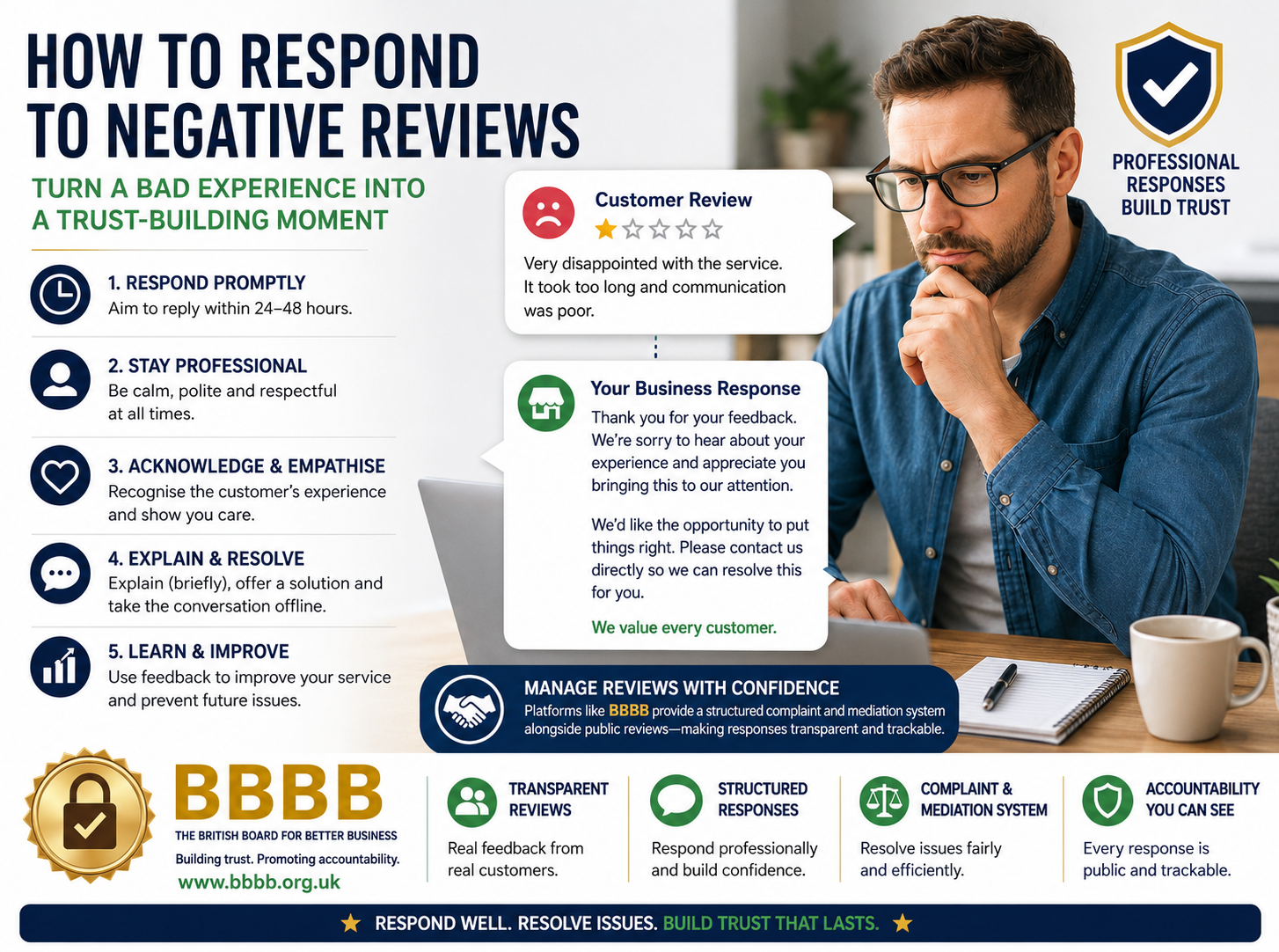
How UK Sole Traders and Small Businesses Can Handle Customer Complaints Professionally: A Step-by-Step Guide
Turn Customer Complaints into Opportunities to Build Trust
Every business receives complaints from time to time.
Whether you’re a sole trader, tradesperson, freelancer, consultant, retailer, or small business owner, dealing with unhappy customers is simply part of doing business.
The good news is that complaints do not have to damage your reputation.
In fact, when handled professionally, a complaint can actually increase customer confidence and demonstrate your commitment to excellent service.
This guide explains a practical step-by-step process that UK small businesses can use to handle complaints effectively, protect their reputation, and turn negative experiences into trust-building opportunities.
Why Complaint Handling Matters
Many business owners fear complaints.
However, customers do not expect perfection.
What they do expect is:
- Acknowledgement
- Communication
- Fairness
- Professionalism
- Accountability
Research consistently shows that customers are often more loyal to businesses that resolve problems well than businesses that never encounter problems at all.
How you handle a complaint may be more important than the complaint itself.
Step 1: Acknowledge the Complaint Quickly
The biggest mistake many businesses make is waiting too long to respond.
When customers feel ignored, frustration increases.
As a general rule:
Aim to acknowledge complaints within:
- 24 hours where possible
- 48 hours at the latest
You don’t need to have the solution immediately.
A simple acknowledgment can be enough:
“Thank you for bringing this to our attention. We are reviewing the matter and will get back to you shortly.”
This demonstrates professionalism and reassures the customer that their concern is being taken seriously.
Step 2: Listen Carefully and Gather Facts
Before responding in detail:
- Read the complaint carefully
- Review any emails or messages
- Check invoices, quotes, and records
- Gather all relevant information
Avoid jumping to conclusions.
Your goal is to understand:
- What happened?
- What is the customer unhappy about?
- What outcome are they hoping for?
Many complaints are caused by misunderstandings rather than deliberate mistakes.
Step 3: Stay Calm and Professional
Complaints can feel personal, especially when you’ve worked hard to satisfy a customer.
However, emotional responses rarely help.
Avoid:
- Arguing
- Blaming
- Becoming defensive
- Responding in anger
Instead:
- Stay polite
- Remain factual
- Focus on resolving the issue
Future customers may judge your professionalism by how you respond.
Step 4: Keep a Written Record
Good documentation protects everyone involved.
Keep records of:
- Emails
- Text messages
- WhatsApp conversations
- Quotes
- Invoices
- Photographs
- Site notes
Documentation helps:
- Clarify facts
- Avoid misunderstandings
- Support fair outcomes
For sole traders and SMEs, organised records can save significant time and stress.
Step 5: Communicate Clearly
Customers appreciate regular updates.
If an investigation is required:
Tell them:
- What you are doing
- When you will respond
- What happens next
For example:
“We’re reviewing the information and will provide an update within three working days.”
Clear communication reduces uncertainty and frustration.
Step 6: Focus on Solutions, Not Blame
The objective is not to win an argument.
The objective is to resolve the issue.
Ask yourself:
- Can the work be corrected?
- Is a partial refund appropriate?
- Is further explanation required?
- Is there a reasonable compromise?
Customers often value effort and fairness as much as the final outcome.
Step 7: Confirm the Resolution
Once an agreement has been reached:
- Confirm it in writing
- Outline any actions to be taken
- Provide realistic timescales
This creates clarity for both parties and reduces the risk of future misunderstandings.
Step 8: Learn from the Experience
Every complaint provides valuable information.
Ask:
- What caused the issue?
- Could it have been prevented?
- Do we need to improve communication?
- Are our systems clear enough?
Businesses that learn from complaints often improve faster than those that ignore them.
Step 9: Protect Your Reputation Through Transparency
Increasingly, customer feedback is visible online.
This means future customers can often see how businesses respond to criticism.
Professional responses demonstrate:
- Accountability
- Customer care
- Integrity
- Confidence
A well-handled complaint can actually strengthen your reputation.
Step 10: Create a Simple Complaint Process
Every business should have a basic complaint process, even if it’s informal.
A simple framework might look like this:
Receive the complaint
↓
Acknowledge within 24–48 hours
↓
Gather facts and documentation
↓
Communicate professionally
↓
Propose a solution
↓
Confirm the outcome
↓
Learn and improve
This process helps ensure consistency and professionalism.
Turning Complaints into Trust-Building Opportunities
Many customers understand that problems occasionally happen.
What they want to see is how a business responds.
A business that:
- Listens
- Communicates
- Takes responsibility
- Resolves issues fairly
often earns more trust than one that never receives feedback at all.
This is why accountability is becoming increasingly important in today’s marketplace.
How BBBB Supports Professional Complaint Handling
Many sole traders and small businesses do not have dedicated customer service teams or formal complaint management systems.
Platforms such as BBBB help provide a structured framework for handling customer concerns professionally.
BBBB allows businesses to:
- Collect customer feedback
- Respond to concerns
- Demonstrate accountability
- Show how issues are resolved
- Build trust with future customers
By making accountability visible, businesses can turn complaint handling into a trust-building exercise rather than simply a damage-control exercise.
For many customers, seeing that a business responds professionally to issues can be just as reassuring as reading positive reviews.
Common Complaint Handling Mistakes to Avoid
Avoid:
❌ Ignoring complaints
❌ Responding emotionally
❌ Delaying communication
❌ Failing to keep records
❌ Arguing publicly
❌ Making promises you cannot keep
Professionalism and consistency are usually the best approach.
Final Thoughts
Customer complaints are an unavoidable part of running a business.
However, they do not have to damage your reputation.
By responding quickly, communicating clearly, documenting properly, and focusing on solutions, sole traders and small businesses can turn complaints into opportunities to demonstrate professionalism and build trust.
Customers remember how they were treated.
Businesses that handle complaints well often create stronger relationships and better reputations as a result.
About BBBB
BBBB helps UK sole traders and small businesses build trust online through professional business profiles, customer reviews, Trust Seals, and transparent accountability.
Businesses can create a free profile in under two minutes and use BBBB’s structured complaint handling framework to demonstrate professionalism and customer commitment.
Learn more at:
Frequently Asked Questions
How quickly should a business respond to a complaint?
Ideally within 24 hours and no later than 48 hours.
Should customer complaints always be documented?
Yes. Written records help protect both the business and the customer.
Can complaints improve customer trust?
Yes. Customers often judge businesses by how they resolve problems rather than whether problems occur.
Why is accountability important?
Accountability demonstrates professionalism and reassures future customers that concerns will be handled fairly.
How does BBBB help with complaint resolution?
BBBB provides a structured framework that allows businesses to respond to concerns, demonstrate accountability, and show future customers how issues are handled professionally.
Read more: